Balancing the Playbook and the Textbook: How Student-Athletes Manage Tight Deadlines
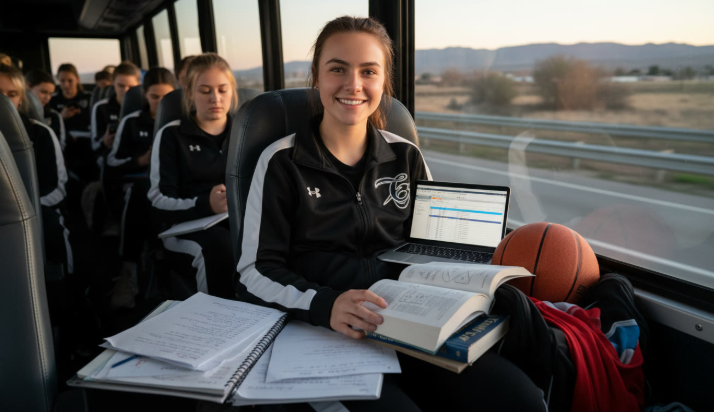
For any college student, the “Sunday Scaries” are a real phenomenon. You’re staring down a 1,500-word research paper, a mountain of required reading, and a looming chemistry quiz. Now, imagine adding a four-hour practice, a mandatory weight-lifting session, and a cross-country flight for an away game to that mix.
This is the daily reality for the student-athlete. While the roar of the crowd and the thrill of the win are what people see on TV, the quiet struggle happens at 1:00 AM in a hotel lobby, trying to find a working Wi-Fi signal to submit a midterm. Balancing a playbook and a textbook isn’t just a challenge—it’s a high-stakes performance art.
The Myth of the “Easy” Schedule
There is a common misconception that student-athletes have it easy. People assume they get preferential treatment or “mickey mouse” courses. The truth is actually the opposite. In most major programs, athletes are required to maintain a specific GPA to remain eligible to play. If the grades slip, the jersey stays in the locker.
Most athletes wake up before the sun. Between 5:00 AM workouts and evening film sessions, their “free” time is often sliced into 30-minute intervals. When you only have a small window between a team meeting and a bus departure, procrastination isn’t just a bad habit—it’s a career-ender. This is why many students in this position eventually look for professional Assignment Writing Help to ensure their academic standing remains as solid as their defensive line.
Mental Shifting: From the Field to the Library
One of the hardest parts of being a student-athlete isn’t the physical exhaustion; it’s the mental “task-switching.” How do you go from a high-adrenaline environment where you are literally fighting for a win, to a silent library where you need to analyze 18th-century literature?
The brain requires time to decompress. However, athletes don’t have the luxury of “winding down.” They have to be masters of focus. This “on-off” switch is a skill that serves them well later in life, but during the semester, it can lead to burnout. Learning to compartmentalize—leaving the stress of a lost game off the page of a term paper—is the secret sauce of the successful graduate-athlete.
The Travel Trap
Travel is the ultimate disruptor. While their classmates are attending lectures and participating in study groups, athletes are often in transit. Buses, planes, and hotels become the new classrooms.
The “Travel Trap” occurs when a student-athlete loses track of time zones or misses crucial in-class announcements. Missing a single lecture can feel like missing an entire month of content. When the workload piles up during a tournament run, seeking Essay Writing Help becomes a strategic move. It’s about more than just getting the work done; it’s about maintaining a high standard of quality when your physical body is drained of energy.
Strategies for Winning the Academic Game
If you are an athlete—or just a student with a schedule that feels like a professional sport—there are a few ways to stay ahead of the curve:
- The 48-Hour Rule: Never wait until the night before. If a paper is due Friday, an athlete’s internal deadline must be Wednesday. This accounts for unexpected practice overruns or travel delays.
- Utilize the “Dead Time”: Those 15-minute intervals in the training room while getting iced? That’s time for flashcards. The bus ride to the stadium? That’s time for reading a chapter.
- Communicate with Professors: Most instructors are willing to work with athletes, but only if they are notified weeks in advance. If you show up the day after a missed quiz with an excuse, you’ve already lost.
- Audit Your Energy: Don’t try to write your most difficult thesis at 11:00 PM after a grueling practice. Wake up an hour earlier when your brain is fresh, even if your muscles are sore.
See also: Why Neckband Headphones Are Trending in Pakistan This Year
The Psychology of Academic Pressure
We often talk about the pressure of hitting a game-winning shot, but the pressure of a looming GPA requirement can be just as heavy. For many athletes, their scholarship—and therefore their future—depends on their performance in the classroom.
This creates a unique type of stress. While a “regular” student might be okay with a C-, an athlete might be one “C” away from losing their spot on the team. This high-stakes environment requires a level of discipline that most adults don’t master until their 30s. They have to be disciplined with their sleep, their diet, and most importantly, their time management.
Why Support Systems Matter
No championship team wins without a great coaching staff. The same applies to academics. Successful student-athletes utilize every resource available to them. This includes academic advisors, tutors, and peer study groups.
In the modern digital age, these resources have expanded. Having a reliable “academic coach” or a service that can provide clarity on complex topics is essential. Whether it’s understanding a difficult prompt or structuring a complex argument, getting help is a sign of intelligence, not a sign of weakness.
Conclusion
At the end of the day, the “student” comes before “athlete” for a reason. Very few college players go pro in their respective sports, but 100% of them will need to turn pro in their careers. The skills learned while balancing a playbook and a textbook—grit, time management, and the ability to perform under pressure—are the exact skills that top-tier employers are looking for.
Managing tight deadlines isn’t just about passing a class; it’s about proving to yourself that you can handle whatever life throws at you, whether it’s a blitz on the field or a surprise essay on a Monday morning.